32 professional football teams will play this week. Each one of them
hits the field with a game plan. I work in the construction industry
where massive buildings are built and for each one there is a very
detailed set of blueprints, covering every aspect of the build. You
wouldn't take off on a long road trip without a map or GPS.
So why
do we think we can win with our finances without having a budget? A
budget is simply you telling your money where to go, instead of
wondering where it went. It's making every dollar count.
Not sure how to do a budget? Here ya go...
And here's a link to free, downloadable forms to make it even easier...
Nov 26, 2014


Nov 24, 2014
Nov 21, 2014
God Behind Bars
Each Friday night I host the God Behind Bars service at Goose Creek Correctional Center. God Behind Bars uses a video service from Central Christian Church of Las Vegas, NV to bring the gospel message to the men. God Behind Bars is in almost 20 prisons across the United States.
We've been doing the God Behind Bars service at Goose Creek for about 13 months. We've had as many as 110 men attending service, but currently we are running about 70 each week.
The video below is God Behind Bars newest informational video. You can also visit their website at GodBehindBars.com .
We've been doing the God Behind Bars service at Goose Creek for about 13 months. We've had as many as 110 men attending service, but currently we are running about 70 each week.
The video below is God Behind Bars newest informational video. You can also visit their website at GodBehindBars.com .
GBB from PlainJoe Studios on Vimeo.
Aug 5, 2014
More Hoonah...
The other day the sister-in-law was in my old stompin' grounds at Hoonah and took a bunch of pictures for me. I've already posted some of them here, and here's the rest. You can click on the image to see a larger version
 The Presbyterian Church. It's been there since the '20s if I remember right...

The school with the pool and the new gym they built after I left.


 L. Kane Store. It's been around forever...

 I'm pretty sure this is the house that my best friend in the 8th grade lived in.
Aug 1, 2014
A Far North Oasis
I came across this article written by a local pastor who ministers out at Goose Creek Correctional Center.
Pastor Guisinger has been doing prison ministry for decades and has been ministering at Goose Creek since the doors opened. He also pastors a great local church and is involved in community wide outreaches.
Some highlights from the article:
"As the Goose Creek population began to increase, so did attendance at our services. The small area designated by the administration for a “chapel” was fast becoming overcrowded. We mentioned to a shift sergeant that at the rate of growth we were experiencing, we would have to soon move into the gymnasium. “That ain’t going to happen,” he replied. Two weeks later it did. Services are now held on Friday and Sunday nights as well. God has a plan!"
"This fledgling church has its own team of greeters, ushers and service leaders and has developed an outstanding praise and worship team that continues to expand its abilities."
"Christ is raising up a thriving church in the middle of a spiritually dark place. The Christians’ testimonies are being lived out in front of other inmates, and it is having a life-changing effect. The weekly inmate-driven praise/worship/Bible study hour has already quickly outgrown the existing chapel area. Inmates are waiting in line to give their personal testimonies."
A FAR NORTH OASIS
Pastor Guisinger has been doing prison ministry for decades and has been ministering at Goose Creek since the doors opened. He also pastors a great local church and is involved in community wide outreaches.
Some highlights from the article:
"As the Goose Creek population began to increase, so did attendance at our services. The small area designated by the administration for a “chapel” was fast becoming overcrowded. We mentioned to a shift sergeant that at the rate of growth we were experiencing, we would have to soon move into the gymnasium. “That ain’t going to happen,” he replied. Two weeks later it did. Services are now held on Friday and Sunday nights as well. God has a plan!"
"This fledgling church has its own team of greeters, ushers and service leaders and has developed an outstanding praise and worship team that continues to expand its abilities."
"Christ is raising up a thriving church in the middle of a spiritually dark place. The Christians’ testimonies are being lived out in front of other inmates, and it is having a life-changing effect. The weekly inmate-driven praise/worship/Bible study hour has already quickly outgrown the existing chapel area. Inmates are waiting in line to give their personal testimonies."
Jul 30, 2014
Not in My Back Yard?
One of the challenges I've faced in recruiting volunteers for ministry at Goose Creek Correctional Center is the fact that it sits almost an hour out of town in the middle of no where. When they were beginning to plan what would become Goose Creek, they had several sites they were considering. Half of the sites were remote, the other half were located in more populated areas. When the list of sites near populated areas came out, there was a loud squawking of people who did NOT want a prison anywhere near them. So it wound up at the end of the road.
But I've always thought living near a prison would be the safest place to be. The bad guys are stuck behind big walls surrounded by security staff. In the 18 years I've lived in the valley, I can only think of one prison escape I've heard of from the pre-trial facility in downtown Palmer. And if someone did manage to escape, they aren't going to hang around...
So the other day I came across this article: http://www.correctionsone.com/cook-county-jail/articles/7403138-Neighborhood-residents-feel-safer-living-near-jail/
From the article: "Residents who live near the Cook County Jail on South Sacramento Avenue are used to the sights and sounds of inmates – and they also feel safer. “We feel more protected here,” resident Francisco Salgado said of the marked and unmarked sheriff patrol cars that are a continuous presence on the street"
“We always see police outside,” said Leticia Bahena. “We used to live in another neighborhood with gang bangers hanging around. It’s quiet here, not like other streets.”
My truck had some issues this winter and died on me one Friday night as I was leaving the prison. The brother-in-law came and picked me up and I left the truck overnight until the father-in-law could come and help me get it going. Christy was concern about leaving the truck unattended there. But as I pointed out, there's cameras everywhere, security staff, and a pickup-truck on constant patrol. There's no place that could be safer!
But I've always thought living near a prison would be the safest place to be. The bad guys are stuck behind big walls surrounded by security staff. In the 18 years I've lived in the valley, I can only think of one prison escape I've heard of from the pre-trial facility in downtown Palmer. And if someone did manage to escape, they aren't going to hang around...
So the other day I came across this article: http://www.correctionsone.com/cook-county-jail/articles/7403138-Neighborhood-residents-feel-safer-living-near-jail/
From the article: "Residents who live near the Cook County Jail on South Sacramento Avenue are used to the sights and sounds of inmates – and they also feel safer. “We feel more protected here,” resident Francisco Salgado said of the marked and unmarked sheriff patrol cars that are a continuous presence on the street"
“We always see police outside,” said Leticia Bahena. “We used to live in another neighborhood with gang bangers hanging around. It’s quiet here, not like other streets.”
My truck had some issues this winter and died on me one Friday night as I was leaving the prison. The brother-in-law came and picked me up and I left the truck overnight until the father-in-law could come and help me get it going. Christy was concern about leaving the truck unattended there. But as I pointed out, there's cameras everywhere, security staff, and a pickup-truck on constant patrol. There's no place that could be safer!
Jul 10, 2014
Hoonah...
On and off for about six years of my young life, I lived in a logging camp near the Southeast village of Hoonah. This would've been in 1984, some of 1986 and 1987-1990. I've only been back to visit one time since I moved away in May of 1990.
My sister-in-law was in Hoonah for work recently and texted me some pictures. It brought back quite a few memories....
 This building is currently the Misty Bay Lodge. But back in the day it was
 Northern Harbor Light's Store. I worked here for two years while I was in high school as a stocker, cashier and janitor. I'd work 5 1/2 hours after school each day and then 8 hours a day on the weekends. So I was getting close to 40 hours a week. I don't think they let teens work those kinds of hours during the school year anymore...
On freight weeks, I'd work even more. About once a month the barge would come in from Seattle with groceries for the store. It seems like it would always come in the middle of the night and then it would be a mad dash to get the trailers unloaded and back on the barge before it left. Unloading the freight was a frenzied chaos, but it was a ton of fun.
 This is Mary's Restaurant. Back in the day it was Mary's Cafe. It seems like it also had another name for awhile... I can't quite remember it even though it's on the tip of my tongue. Maybe it was the Tlingit word for shark...
Anyway, I remember my eight grade year, me & Chad Stavely would go here after school and get a large order of fries and split it. We'd usually wind up fighting about who got more.
Half the time we'd forget to pay when we left. The beauty of a small town is that they would hold the check until we came in next time.
When the State of Alaska finally got around to paving and widening the roads in Hoonah, the cafe was too close to the road. So they built more pilings behind it and slid the whole thing back. It was pretty impressive to watch.
 While we lived in Hoonah we attended the Assembly of God church there. When we first started going, the church met in a large room in the parsonage. Later we rented the catholic church. We'd have our service from 8:30 to 10:00 and then clear out so the Catholics could meet at 10:30. John & Joyce Moropoulos were the pastors at that time, before they went to Greece as missionaries.
Getting our own building was a priority, and towards the end of my time there, the church was able to build a beautiful facility.
 This wall panel is being carved for a traditional Tlingit tribal house that is going to be built at Glacier Bay, the original home of the Huna people. Gordon Greenwald is one of the artist working on this piece. He was my favorite teacher and taught a Northwest Native Art class. I still have a canoe paddle and bentwood box that I made in his class.
 Speaking of school.... I walked up those steps every school day for 3 1/2 years. At the time, I hated living in Hoonah. No movie theater, no fast food, no shopping, nothing. It seemed like prison. But looking back, the school provided a great education.
 The cop shop. I've been in there before... Not for anything nefarious though. Obviously there was no DMV for getting your driver's license. So you could go to the police station and take a written test. This would get you an "off system" license that could be used for driving in rural Alaska. I don't think they do that sort of thing anymore.
 I'm pretty sure this picture was taken at Gartina Creek. I remember John Elkins and I fishing for chum salmon on this creek. Towards the end of the salmon run, the banks of this creek was covered in dead and rotting salmon. The stench was almost unbearable. Long before the Lion King, I learned that the circle of life doesn't end well.
 As I mentioned, I didn't actually live in Hoonah. We lived at the Whitestone Logging camp about 7 miles from Hoonah. Whitestone Logging started out as Tyler Brothers Logging. They had been around for a long time and some people in camp had been working for them for over 20 years. We came up from Oregon in 1981, when the camp was at St. John's Harbor on Zarembo Island. From there the camp moved to Cape Pole for a short time and then to Hoonah in 1984. Originally the camp was going to be at Whitestone Harbor, hence the name.
Anyone that spent time in camp should recognize this picture. It was the mail slots at the commissary. Everyone in camp had the same mailing address. The mail was picked up in town each day and brought out and sorted into each family's box. In those pre-internet days, the mail was one of our few connections to the "real world" or as we called it: "down south."
 It's well past it's glory days, but this was the extent of our shopping options in camp. The commissary. Here's where the loggers could buy work clothes, toiletries and other supplies. And for us kids, it's where we could buy CANDY!! My favorite was the bucket of red licorice where you could buy it for 5 cents a stick.
I don't think the white self thing in the middle of the picture was there in my day. But I'm pretty sure the other shelves and counters are exactly the ones that use to hold the yummy goodness.
I remember there was a side door that was hardly ever used that had a padlock on it. At one point one of the older kids in camp managed to cut the lock off and put on his own padlock. No one noticed for a long time since the door wasn't used. He'd go in at night and steal candy and tobacco. He was smart enough to not take too much at one time and arouse suspicion.
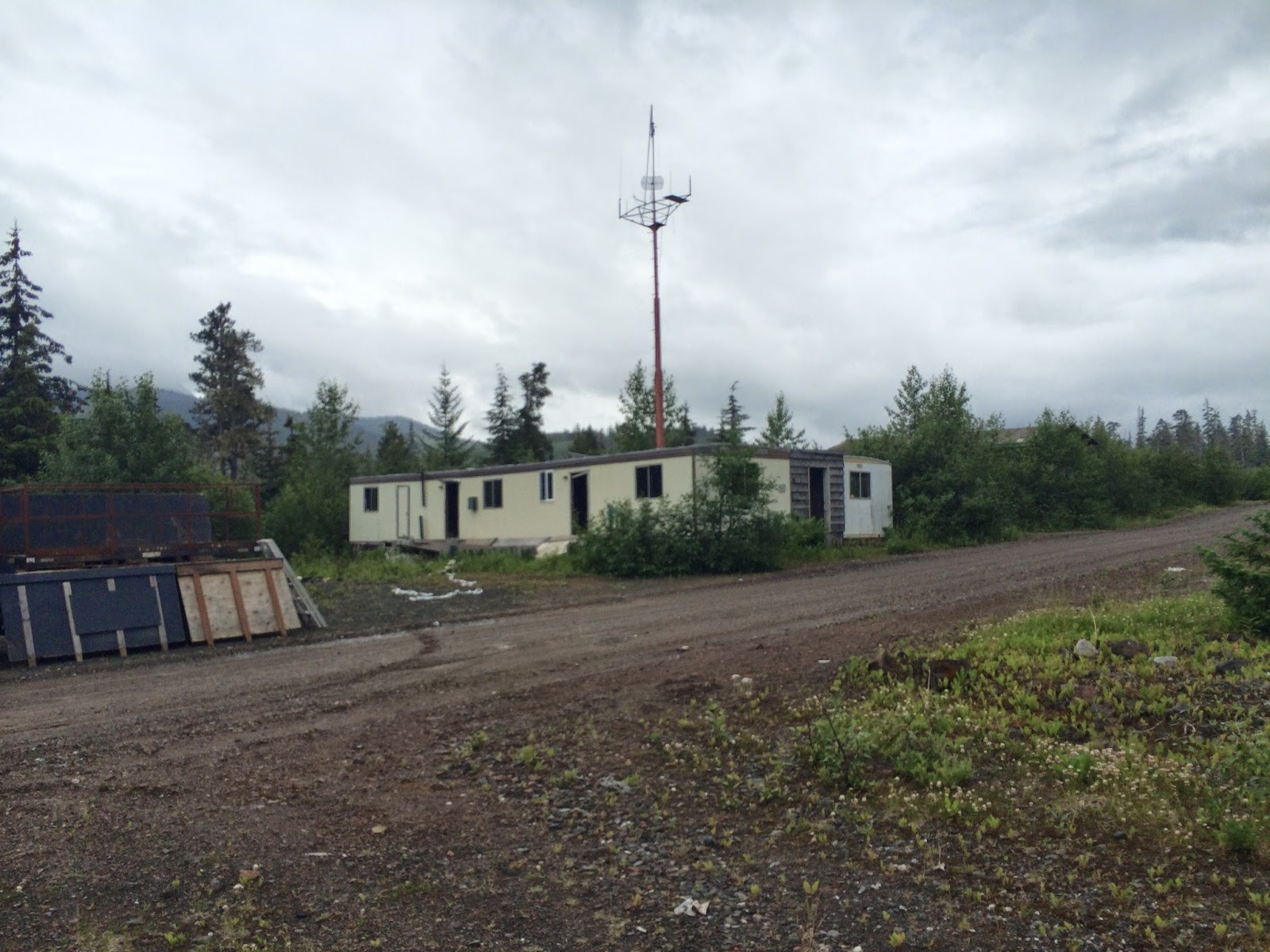 This building was the main office. My mom worked in the office most of the time that we lived in camp. It was made up of modular trailers. Everything in the camp was set up to be portable and easily moved. Obviously the building has been long neglected and is rough shape. But what seems weirdest to me is there isn't a grey Chevy six-pack pickup in front. That was the boss's truck and was usually parked in front.
 This building was the cook house. The logging camp had trailer houses for the "home guards". These were the employees who's family lived in camp. And then there where bunkhouses for the guys who were single, or whose family's still lived down south. The cookhouse was for the bunkhouse guys. They ate breakfast and dinner here. At breakfast there was a spike table set out with all the fixin's for lunch. Being home guard, I never got to eat in the cookhouse, but I was always told the cooks did an amazing job.
 I'm pretty sure this is a section of bunkhouse. They were usually made up of Atco trailers connected by walkways. Two guys would share one room. There was about 250 people that lived in camp at one point. It was one of the larger logging camps in Alaska.
Because of the amount of snow we would get, the bunkhouses and trailers would often have a sloped metal roof built over them; allowing the snow to slide off. I remember one year a bunkhouse guy left his pick up parked under the edge of one of the roofs while he went home for the winter. All the snow sliding off the roof and piling up on the truck cause the leaf springs to snap.
 It looks like there is still at least one trailer left in camp. And it looks like the brush has grown up quite a bit. The camp was one giant gravel pad with rows of trailers. So there was no playing in the lawn for me when I was growing up. It was all rock. So we'd head out to play in the woods. A group of us spent two summers chopping down smaller trees and building log cabins. Well, they weren't really cabins. We never figured out how to do doors or roofs. So the "cabins" where just four log walls. We'd dig out a hole under the wall to crawl in and out of . Or climb up and over the wall. But it kept us busy and out of trouble. Mostly...
 This was the view of the small bay out in front of camp. Living there, I never appreciated how amazing the place I lived was. We could fish in the bays for salmon and halibut, we could fish in the creeks for salmon, we could hunt deer. We had amazing sights and scenery all around us.
Just as I was getting ready to wrap up this post, my sister-in-law sent me another batch of photos. Those will have to wait for another time.
My sister-in-law was in Hoonah for work recently and texted me some pictures. It brought back quite a few memories....
On freight weeks, I'd work even more. About once a month the barge would come in from Seattle with groceries for the store. It seems like it would always come in the middle of the night and then it would be a mad dash to get the trailers unloaded and back on the barge before it left. Unloading the freight was a frenzied chaos, but it was a ton of fun.
Anyway, I remember my eight grade year, me & Chad Stavely would go here after school and get a large order of fries and split it. We'd usually wind up fighting about who got more.
Half the time we'd forget to pay when we left. The beauty of a small town is that they would hold the check until we came in next time.
When the State of Alaska finally got around to paving and widening the roads in Hoonah, the cafe was too close to the road. So they built more pilings behind it and slid the whole thing back. It was pretty impressive to watch.
Getting our own building was a priority, and towards the end of my time there, the church was able to build a beautiful facility.
Anyone that spent time in camp should recognize this picture. It was the mail slots at the commissary. Everyone in camp had the same mailing address. The mail was picked up in town each day and brought out and sorted into each family's box. In those pre-internet days, the mail was one of our few connections to the "real world" or as we called it: "down south."
I don't think the white self thing in the middle of the picture was there in my day. But I'm pretty sure the other shelves and counters are exactly the ones that use to hold the yummy goodness.
I remember there was a side door that was hardly ever used that had a padlock on it. At one point one of the older kids in camp managed to cut the lock off and put on his own padlock. No one noticed for a long time since the door wasn't used. He'd go in at night and steal candy and tobacco. He was smart enough to not take too much at one time and arouse suspicion.
Because of the amount of snow we would get, the bunkhouses and trailers would often have a sloped metal roof built over them; allowing the snow to slide off. I remember one year a bunkhouse guy left his pick up parked under the edge of one of the roofs while he went home for the winter. All the snow sliding off the roof and piling up on the truck cause the leaf springs to snap.
Just as I was getting ready to wrap up this post, my sister-in-law sent me another batch of photos. Those will have to wait for another time.
Subscribe to:
Posts (Atom)